
Two deserts, two different trips
From Marrakech you can reach two deserts, and they have almost nothing in common. Agafay starts 25 km from the city centre: you can be driving there in the late afternoon and back at your hotel for dinner. The Sahara, the one with the dunes, starts about nine hours to the south-east.
So the useful question is not which one is more beautiful. It is how many days you have, what kind of landscape you came for, and what you want to do once you are standing in it. The answer shifts depending on whether your stay is four days or ten.
We run buggy and quad tours in Agafay, and we do not operate Sahara trips. What follows is a comparison rather than a pitch: where the Sahara is the right call, we say so.
Agafay is stone, not sand
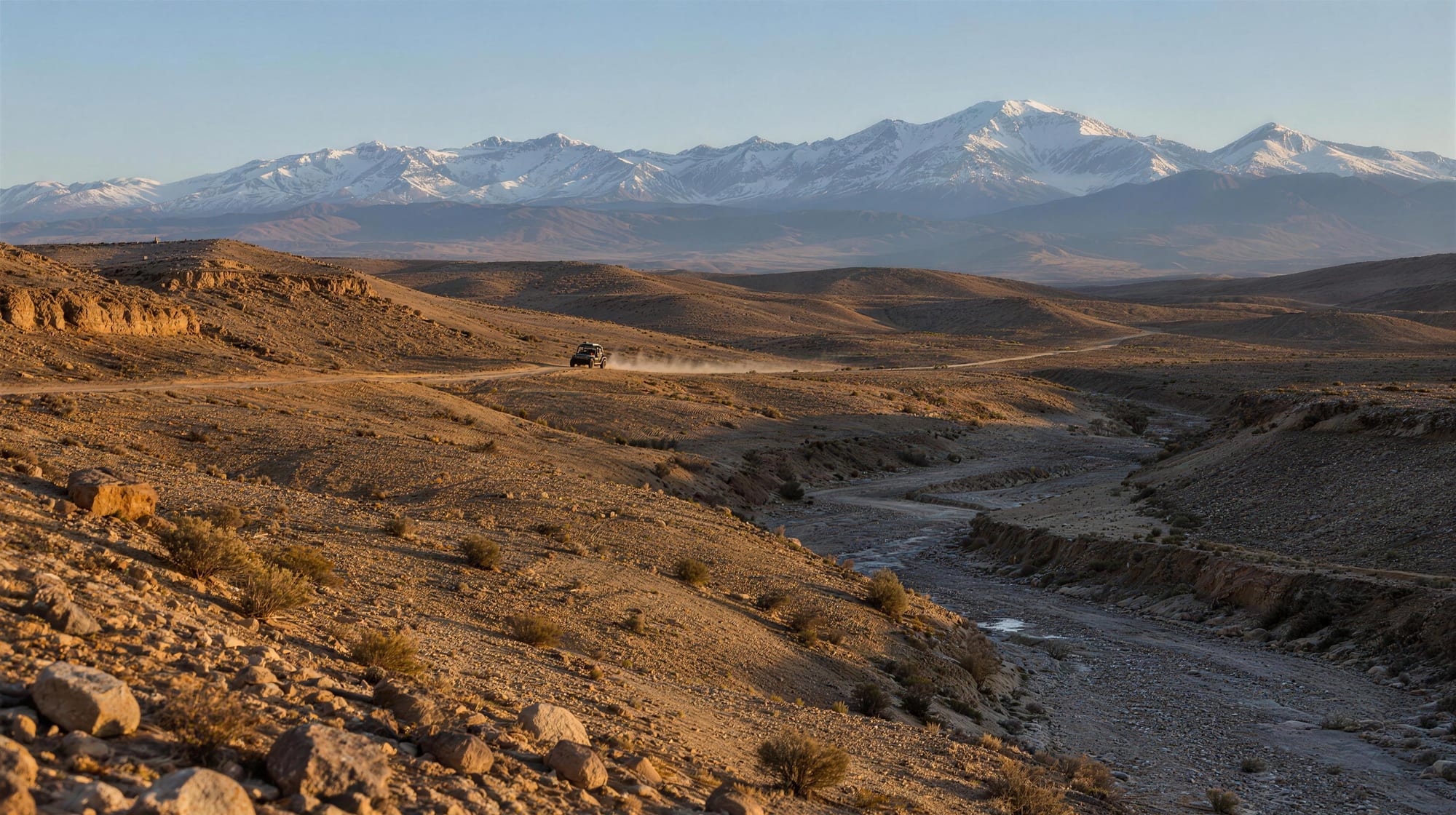
Agafay is a stone desert, what geographers call a reg. You get ochre plateaus, rounded rocky hills, dry riverbeds cut into the ground, and a scattering of thorn bushes. There is not one sand dune on it.
That is worth settling early, because plenty of photos online suggest otherwise. If you came for fine sand running through your fingers, Agafay will let you down. If you came for an open, empty, mineral landscape, it gives you exactly that.
The plateau sits between 550 and 700 m above sea level, and the altitude matters. The air is drier than in the city, the wind moves across it, and the High Atlas closes the horizon to the south-east. For much of the year those summits hold snow, so you photograph warm rock with a white ridge behind it.
The Sahara: real dunes, nine hours away
The nearest sand dunes are at Merzouga to the east, or Zagora to the south. Either way, plan on nine to ten hours of driving: the Atlas passes first, then long straight roads heading south.
That is not a day trip. Two days is the minimum and three is more realistic if you would rather not spend your holiday in a minibus: one day down, one night on the sand, one day back. Two-day Merzouga tours exist, but they leave you little time on the dunes themselves.
What you get in exchange is real: tall dunes, a different quality of silence, a night sky with no city glow, and stops along the way such as the Dades gorges or the Draa valley. If the dunes are the point of your trip, take those three days.
The deciding factor: how many days you have
On a four- or five-day stay, a Sahara round trip eats half the itinerary and most of your energy. Agafay fits into half a day: leave mid-afternoon, ride, eat at a camp, be back in the evening. The medina, the souks and the gardens stay on your list.
From eight days upwards the sum works out differently. Plenty of travellers do both, and the sequence holds up: a three-day loop to Merzouga or Zagora for the dunes, then a half day in Agafay near the end, when there is no longer time to go far.
One practical note. With small children, or with older parents, ten hours in a vehicle each way is a real cost. Agafay stays within reach of everyone, and a session can be cut short if anyone has had enough.
What there is to do
The terrain in Agafay suits driving. Packed dirt tracks, dry riverbeds and stony climbs are what make a buggy or a quad worthwhile here: grip, gradient, and a long view ahead. That is our main activity, one or two hours depending on the route.
The rest revolves around the camps: a camel ride at the end of the day, lunch or dinner under canvas, an overnight bivouac for those who want to stay. Many visitors pair a late-afternoon ride with dinner at a camp after sunset.
The Sahara works in another register: camel treks of a few hours or several days, sandboarding, 4x4 runs between dune ridges, camps pitched at the foot of the sand. Driving on sand is its own skill, and out there distances are counted in days, not minutes.
Light and photographs: what to expect
In Agafay the light does the work. At midday the plateau reads flat and grey-beige, with no depth. An hour before sunset the hills fill with long shadows and the rock turns ochre, then pink.
The signature of the place is that contrast: a dry, almost lunar foreground, and behind it the serrated line of the Atlas, often white from November to April. You will not get that at Merzouga, where the horizon is made of sand.
If the picture in your head is the classic one, orange crests, shadows folding in waves, a line of camels on a ridge, that is the Sahara and only the Sahara. Choose the desert that matches the photograph you want to take home.
When to come
Two windows stand out: March to May and September to November, with 20 to 30 °C during the day, clear skies most of the time, and a long, usable late-afternoon light.
Summer is hot on the plateau. Ride early in the morning or at the end of the day, carry water, and skip the midday hours. Winter is mild and sunny with snow on the Atlas, but the temperature drops quickly once the sun is down, so bring a jacket for the drive back.
Rain is rare, a handful of days a year. When it does fall the tracks turn slippery and the dry riverbeds can fill in a short time, so we reschedule or reroute rather than ride.
Getting to Agafay
The Agafay Desert lies in the commune of Oumnass, 25 to 30 km south-west of Marrakech, a city you will also see spelled Marrakesh. The approach is the Amizmiz road, the R203, which leaves town on its south-western side. Allow 30 to 40 minutes from Jemaa el-Fna, a little more when traffic is heavy.
Our base is the Afriquia petrol station at km 16 on the Amizmiz road. It is a simple landmark to give a taxi driver and a simple one to find on a map. Tarmac runs all the way there; the tracks start after it.
Three ways to arrive: your own rental car, a taxi from Marrakech (agree the fare before you get in, and arrange the return), or a transfer we set up from your hotel or riad. Whichever you pick, tell us where you are starting from and the time that suits you, and we will fit the slot around it.